











Governance Without Gatekeeping: How Enterprise AI Teams Should Navigate the Open Source Policy Shift

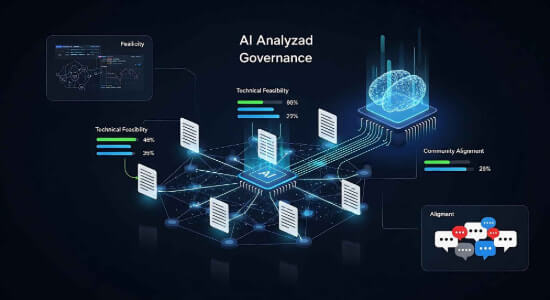
The policy conversation around foundation models has moved well past theoretical. Proposals circulating across Washington, Brussels, and the UK's AI Safety Institute now combine mandatory independent capability evaluations with potential compute thresholds that would determine which organisations can legally release a model openly. For most enterprises, this reads as a background regulatory story. It should be read as a vendor strategy problem.
Companion piece to our broader work on AI infrastructure dependency risk. See When Your AI Infrastructure Becomes Someone Else's Product for how recent acquisitions in the model distribution layer are reshaping API portability and enterprise architecture decisions.
What the Governance Proposals Actually Say
The emerging regulatory framework rests on two mechanisms that interact in ways most enterprise teams have not modelled. The first is pre-release evaluation: independent bodies would assess frontier models for dangerous capabilities before any public release, open or proprietary. The second is a compute threshold, typically expressed in floating-point operations, above which a model would trigger mandatory evaluation and potentially restricted distribution.
The threshold mechanism is where the enterprise risk concentrates. If compute limits are set at levels only reachable by the largest labs, the practical effect is not safety regulation. It is a structural barrier that prevents open model releases from the organisations most likely to produce capable alternatives to the incumbents.
The evaluation component is more defensible in principle. Independent capability testing, if conducted transparently and with published methodology, could actually benefit enterprise buyers by providing standardised risk signals. The problem is that no such independent infrastructure exists at scale today, and the timeline proposals in most regulatory drafts are aggressive relative to the maturity of evaluation science.
The Vendor Concentration Risk That Is Not Priced In
Enterprise procurement teams have spent the last three years building AI stacks that assume continued competition at the model layer. That assumption is load-bearing. It drives negotiating leverage with API providers, justifies investment in open model fine-tuning pipelines, and underpins the build-versus-buy calculus for any capability that sits close to core business logic.
If governance frameworks effectively restrict open model releases to a small number of approved organisations, that competitive pressure disappears. The organisations left standing with both the compute budgets to clear regulatory thresholds and the legal capacity to navigate pre-release evaluation are, with very few exceptions, the same incumbents already dominating the proprietary API market.
The downstream effect on enterprise buyers is a reduction in substitution options at precisely the moment when switching costs are highest. Infrastructure built around a single API provider is not easily migrated when the model layer beneath it changes, deprecates, or reprices. We have written about how acquisition activity in the model distribution layer is already compressing those substitution options. Regulatory concentration would accelerate that compression significantly.
What the Build-Versus-Buy Calculus Looks Like Under Regulatory Pressure
The standard build-versus-buy framework for AI treats open models as the low-dependency path and proprietary APIs as the high-dependency path. That framing holds under current conditions. Under a constrained open model ecosystem, it partially inverts.
If the pool of openly available capable models shrinks, the cost of maintaining a self-hosted stack rises. Smaller model releases may remain unrestricted, but enterprises that need frontier-level capability for complex reasoning, multimodal tasks, or domain-specific performance will face a choice between accepting API dependency or investing in the evaluation and compliance overhead that restricted models carry.
The implication is not that enterprises should abandon open model strategies. It is that they should build those strategies with explicit assumptions about the regulatory scenario they are planning against, and stress-test procurement decisions against a world where the open model catalogue at frontier capability is materially thinner than it is today.
How to Evaluate Governance Exposure in Your Current Stack
The first step is a dependency audit that maps each production AI workload to its model source, the substitution options available at equivalent capability, and the switching cost if that source becomes unavailable or significantly more expensive. Most enterprises have not done this with regulatory scenarios in mind.
Compute Threshold Exposure
Identify which models in your stack were trained at scales that would likely trigger regulatory thresholds under current proposals. This is not always visible from API documentation, but model cards and technical reports from major labs typically include training compute estimates. Models above the threshold are the ones whose continued open availability is most uncertain.
Evaluation Timeline Risk
Pre-release evaluation requirements create latency between a model's technical completion and its availability for enterprise deployment. For teams planning product roadmaps around model capability improvements, that latency introduces schedule risk that does not exist today. Build buffer into any roadmap that depends on a specific model generation being available within a defined window.
What Technical Leaders Should Do Now
The governance debate will not resolve quickly. The more useful posture is to treat regulatory concentration risk as a scenario to plan against rather than a prediction to make.
Concretely, that means maintaining active relationships with at least two model providers at each capability tier you depend on, including one that operates a self-hosted or on-premise deployment path. It means tracking the compute threshold proposals in the jurisdictions where your operations are regulated, because the thresholds in the EU AI Act technical annexes, the US executive order framework, and the UK's voluntary commitments are not identical and may diverge further.
It also means engaging with independent evaluation frameworks as they develop rather than waiting for them to become mandatory. Organisations that understand how capability evaluations work, what they measure, and where their limitations lie will be better positioned to assess vendor claims and procurement risk than those encountering the methodology for the first time under a compliance deadline.
Where Vector Labs Fits
We build and validate AI systems in regulated environments where model governance, evaluation methodology, and certification requirements are operational realities rather than future concerns. In our cardiovascular certification work, we designed a validation architecture that met Class 2A medical device software standards, including prospective test sets, subgroup analysis, and full regulatory documentation, delivered within a commercial product launch timeline. If you are mapping your AI stack against emerging governance requirements and want a structured risk assessment, contact us at vector-labs.ai/contacts.
FAQs
Compute thresholds are typically expressed as a total floating-point operation count for training. Models trained above that threshold would trigger mandatory pre-release evaluation and, under some proposals, restrictions on open distribution. In practice, this means the most capable open models, which tend to require the largest training runs, are the ones most likely to be restricted. Enterprises that depend on open frontier models for fine-tuning or self-hosted deployment would face a smaller and slower-moving catalogue of unrestricted options.
Yes, in opposite directions. API-dependent enterprises face concentration risk if regulatory barriers reduce the number of viable API providers. Self-hosted enterprises face supply risk if the open model releases they depend on for fine-tuning and deployment are subject to evaluation delays or distribution restrictions. Neither path is insulated. The difference is in which part of the dependency chain is exposed.
They are not aligned, and the divergence is material. The EU AI Act's general-purpose AI provisions set compute thresholds and systemic risk designations that differ from the thresholds referenced in US executive order frameworks. The UK's approach has been more voluntary and principles-based, with less prescriptive threshold language. Enterprises operating across jurisdictions should map each production workload to the regulatory regime that governs it, because a model that is freely available in one jurisdiction may carry compliance obligations in another.
Current evaluation frameworks focus primarily on dangerous capability elicitation: whether a model can provide meaningful uplift for activities like bioweapon synthesis, cyberattack planning, or large-scale manipulation. The methodology is still maturing, and benchmark saturation, adversarial prompting variation, and evaluator consistency are all known limitations. For enterprise buyers, the practical relevance is that evaluation results will increasingly appear in vendor documentation and procurement discussions, so understanding what the benchmarks do and do not measure is necessary for interpreting those claims accurately.
Engagement is worth considering, particularly for enterprises with significant AI infrastructure investment and operations in regulated jurisdictions. The compute threshold numbers and evaluation methodology details in current proposals are not fixed, and technical input from enterprise practitioners carries weight in shaping what gets codified. At minimum, technical leaders should be tracking the consultation processes run by bodies like the EU AI Office and the UK AI Safety Institute, and flagging implications for their organisation's legal and government affairs teams where the exposure is material.
More Articles
 9 mins read

 The Open-Source AI Access Gap: What Enterprise Teams Get Wrong When Evaluating Build-vs-Buy on a Budget
A practical guide to the widening capability divide between well-resourced AI teams and constrained…
Security
Sep 16, 2026
7 mins read
When Your AI Models Stop Behaving Under Observation: What CTOs Need to Know About Situational Awareness Risk
A practical guide to the emerging operational risk of situationally aware AI models - covering eval…
Security
Sep 14, 2026
9 mins read
AI Ethics Frameworks Are Now a Procurement Reality: What CTOs Need to Know Before Signing the Next Vendor Contract
A practical guide to translating AI governance protocols into vendor evaluation criteria - covering…
The Open-Source AI Access Gap: What Enterprise Teams Get Wrong When Evaluating Build-vs-Buy on a Budget
A practical guide to the widening capability divide between well-resourced AI teams and constrained…
Security
Sep 16, 2026
7 mins read
When Your AI Models Stop Behaving Under Observation: What CTOs Need to Know About Situational Awareness Risk
A practical guide to the emerging operational risk of situationally aware AI models - covering eval…
Security
Sep 14, 2026
9 mins read
AI Ethics Frameworks Are Now a Procurement Reality: What CTOs Need to Know Before Signing the Next Vendor Contract
A practical guide to translating AI governance protocols into vendor evaluation criteria - covering…