











Voluntary by Default: What the Collapse of Binding AI Oversight Means for Enterprise Compliance Strategy

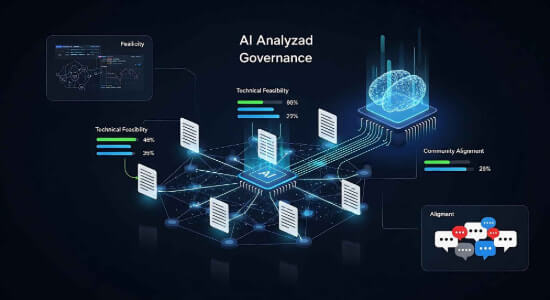
The regulatory architecture for AI in financial services and enterprise technology has followed a consistent pattern over the past several years: binding review mechanisms get proposed, industry engages heavily during comment periods, and the resulting framework lands somewhere between advisory and voluntary. This is not a temporary political condition. It is the structural equilibrium that emerges when regulatory agencies lack both the technical capacity to audit AI systems at scale and the political mandate to impose costs on sectors that are simultaneously driving economic growth. For enterprise compliance and technology leaders, the correct response is not to wait for the floor to stabilise. It is to treat voluntary-by-default as the permanent operating condition and build internal accountability infrastructure that does not depend on external mandates to function.
Companion piece to our broader work on AI accountability architecture. See Who Owns the AI Mistake? Building an Accountability Architecture Before Regulators Force Your Hand for practical guidance on role definitions, incident ownership models, and embedding accountability into the AI development lifecycle.
The FINRA Model and What It Actually Signals
The proposal to extend a FINRA-style self-regulatory model to AI oversight is instructive precisely because it reveals the ceiling, not the floor, of what binding oversight is likely to achieve in practice. FINRA operates through membership obligations and examination authority, but its effectiveness in practice depends on the willingness of member firms to maintain internal compliance cultures that exceed the minimum examination threshold. When that internal culture is weak, FINRA's periodic review cycle is too slow to catch systemic problems before they cause harm.
Applying that model to AI systems introduces a further complication. The examination cadence appropriate for reviewing trading conduct or suitability documentation is structurally mismatched with the deployment velocity of production AI systems. A model that is retrained monthly, or an agentic workflow that changes behaviour in response to new retrieval data, will have drifted significantly between examination cycles. The self-regulatory model assumes a relatively stable product being periodically reviewed. AI systems violate that assumption by design.
The strategic implication for enterprise leaders is that a FINRA-style regime, even if implemented in its strongest proposed form, would not provide the audit trail or the real-time accountability that material AI deployments actually require. Calibrating your internal governance to satisfy an external examination that happens annually is not the same as governing AI systems that make consequential decisions daily.
The Lobbying Pattern as a Structural Signal
The movement from binding to voluntary after industry contact is not best understood as regulatory capture in the pejorative sense. It is more accurately understood as a rational equilibrium between agencies that lack enforcement capacity and industries that can credibly argue that overly prescriptive rules will impede innovation without producing commensurate safety benefits. That argument has structural force regardless of whether it is made in good faith, because regulators cannot easily refute it without the technical infrastructure to measure what safety benefits a given binding rule would actually produce.
This means the pattern will repeat. Each time a binding mechanism is proposed for AI systems, the same dynamics will apply: industry will engage, agencies will lack the measurement capacity to defend specific thresholds, and the resulting framework will move toward principles-based guidance or voluntary commitments. Enterprise leaders who are building multi-year governance programmes should treat this not as a reason to reduce internal investment in accountability infrastructure, but as a reason to increase it. The absence of an external mandate does not reduce the legal, reputational, or operational risk exposure from a consequential AI failure. It simply means that exposure will not be managed by anyone other than you.
What Self-Regulatory Regimes Mean for Procurement
When the regulatory environment is voluntary by default, the due diligence burden in AI procurement shifts substantially onto the buying organisation. A vendor who tells you their model has been reviewed under a voluntary industry framework has told you very little about the actual risk profile of that system in your specific deployment context. Voluntary frameworks typically assess whether a process exists, not whether that process is producing safe or reliable outputs in production.
Model Documentation Standards
The first procurement lever available to enterprise buyers is requiring model documentation that exceeds what any current voluntary framework mandates. This means requesting training data provenance, known failure mode documentation, out-of-distribution behaviour characterisation, and version control policies that specify what constitutes a material model change requiring re-evaluation. These are not exotic requirements. They are the minimum information needed to assess whether a third-party AI system is fit for a specific regulated use case.
Contractual Audit Rights
The second lever is contractual audit rights with teeth. A voluntary framework gives you no standing to demand access to a vendor's internal testing data or incident logs. A well-drafted commercial agreement can. Enterprise procurement teams should treat audit rights for AI systems as equivalent in importance to data processing agreements, and should expect vendors who resist them to be flagged accordingly in risk assessment.
Building Internal Accountability Infrastructure That Does Not Depend on External Mandates
The organisations that will be best positioned when AI regulation does eventually tighten are those that have already built the internal infrastructure that binding regulation would have required. This is not a compliance cost. It is a risk management investment that produces returns regardless of what happens to the regulatory environment.
The core components of that infrastructure are well understood even if they are infrequently implemented in full. Organisations need a clear ownership model that assigns accountability for AI system behaviour to a named role, not a committee. They need an incident classification system that distinguishes between model errors, data errors, and deployment errors, because the remediation path for each is different. They need a model registry that tracks every production AI system, its version history, its approved use cases, and its last validation date.
What is less commonly implemented is the monitoring layer that connects these components in real time. Governance documentation that is updated quarterly cannot catch a model that began producing biased outputs in week two of a new deployment. The accountability infrastructure needs to include automated monitoring that surfaces distributional shifts, output anomalies, and performance degradation to the team responsible for remediation, not just to a dashboard that someone reviews monthly.
Calibrating Risk Frameworks When the Floor Is Uncertain
The practical challenge for compliance and risk leaders is that most enterprise risk frameworks are calibrated against external requirements. When those requirements are voluntary or absent, the internal risk appetite framework has to carry the full weight of the governance decision. That requires a different kind of calibration exercise than most organisations have undertaken for AI specifically.
The starting point is consequence mapping, not probability estimation. For each material AI deployment, the question is not primarily how likely a failure is, but what the consequence of a failure would be across three dimensions: regulatory exposure in the jurisdictions where the system operates, reputational exposure to the customers or counterparties affected, and operational exposure if the system needs to be taken offline during remediation. That consequence map should drive the depth of pre-deployment validation, the frequency of post-deployment monitoring, and the escalation threshold for incidents.
Risk frameworks that treat all AI systems as equivalent regardless of consequence profile will systematically under-govern the systems that matter most and over-govern the systems that matter least. The absence of a regulatory floor that distinguishes between high-stakes and low-stakes AI use cases means that distinction has to be made internally, using a methodology that is documented, defensible, and consistently applied.
Where Vector Labs Fits
We build production AI governance architecture for financial services and enterprise clients, covering accountability frameworks, model registries, and monitoring infrastructure. Our work on credit risk AI for a retail bank, including IFRS 9-compliant probability of default modelling with rigorous out-of-sample validation, is documented at vector-labs.ai/insights, and illustrates how we embed regulatory defensibility into AI systems from the design stage rather than retrofitting it. If you are building internal AI governance infrastructure and want to pressure-test your current approach, contact us at vector-labs.ai/contacts.
FAQs
The absence of AI-specific regulation does not eliminate legal exposure. Existing obligations under consumer protection law, anti-discrimination statutes, financial services conduct rules, and data protection frameworks all apply to AI system outputs regardless of whether a specific AI regulation exists. A model that produces discriminatory credit decisions is not protected from liability because no AI-specific rule was violated. The legal risk is real; it is simply diffuse across existing frameworks rather than concentrated in a single AI statute.
Treat voluntary framework compliance as a process signal, not an outcome guarantee. It tells you the vendor has engaged with a governance process, not that the system is safe or reliable in your specific deployment context. Ask for the specific documentation produced by that process, including test results, known limitations, and the scope of use cases the review covered. If the vendor cannot produce that documentation, the voluntary compliance claim has no evidentiary value for your procurement decision.
The minimum viable structure requires four components: a named accountable owner for each production AI system, a model registry that tracks version history and approved use cases, a pre-deployment validation process that is documented and repeatable, and a post-deployment monitoring process that surfaces anomalies to the accountable owner within a defined timeframe. Anything less than this leaves material gaps in the audit trail that will be difficult to defend if a system failure produces regulatory scrutiny or litigation.
Revalidation frequency should be driven by two triggers: calendar-based review at a cadence proportionate to the consequence profile of the system, and event-based review whenever a material change occurs in the model, the input data distribution, or the deployment context. For high-consequence systems, a quarterly calendar review combined with automated monitoring that flags distributional shifts between reviews is a reasonable baseline. For lower-consequence systems, semi-annual review with the same automated monitoring layer is defensible provided the consequence mapping that justified the lower frequency is documented.
No, and the reasoning is straightforward. The risk exposure from a consequential AI failure exists regardless of whether a binding regulation requires you to manage it. If binding regulation does arrive, organisations with mature internal governance will be better positioned to demonstrate compliance at lower incremental cost. If it does not arrive, the internal infrastructure still reduces operational, reputational, and legal risk from system failures. The investment case does not depend on regulatory certainty.
More Articles
 7 mins read

 What the DOJ's OpenAI Filing Actually Means for Enterprise AI Legal Risk
A practical analysis of how the U.S. Justice Department's intervention in the NYT v. OpenAI copyrig…
Security
Sep 04, 2026
9 mins read
When AI Runs the Attack: What the First Documented Agentic Breach Means for Enterprise Security Architecture
A practical analysis of how a frontier AI-assisted intrusion compressed two weeks of red-team trade…
Security
Aug 24, 2026
9 mins read
Physical AI in Public Infrastructure: What the Enforcement Gap in Deployed Robotics Tells Enterprise Buyers
A strategic analysis of what real-world humanoid robot deployments in public safety roles reveal ab…
What the DOJ's OpenAI Filing Actually Means for Enterprise AI Legal Risk
A practical analysis of how the U.S. Justice Department's intervention in the NYT v. OpenAI copyrig…
Security
Sep 04, 2026
9 mins read
When AI Runs the Attack: What the First Documented Agentic Breach Means for Enterprise Security Architecture
A practical analysis of how a frontier AI-assisted intrusion compressed two weeks of red-team trade…
Security
Aug 24, 2026
9 mins read
Physical AI in Public Infrastructure: What the Enforcement Gap in Deployed Robotics Tells Enterprise Buyers
A strategic analysis of what real-world humanoid robot deployments in public safety roles reveal ab…