







AI Governance as Infrastructure: Why the Proxy Layer Between Your Apps and Your Models Is the Most Important Architectural Decision You Haven't Made Yet

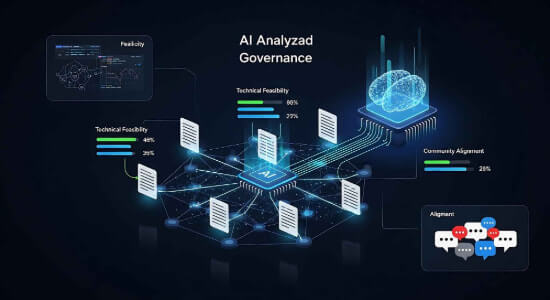
Most engineering teams treat AI governance the way they treat fire extinguishers: they know they need one, they put it somewhere visible, and they hope they never have to think about it again. The result is production AI systems where spend limits are whatever the provider defaulted to, capability boundaries are wherever the first integration landed, and switching providers means touching every application that ever made a direct API call. This article makes the case that a governance proxy layer sitting between your applications and your model providers is not a compliance feature. It is a core infrastructure decision with direct consequences for cost, agility, and competitive positioning.
The Lock-In You Didn't Notice You Were Building
Provider lock-in in AI systems rarely happens through a deliberate architectural choice. It accumulates through dozens of small decisions: a direct SDK import here, a hardcoded model name there, a response parser written against one provider's specific output schema.
By the time an organisation realises it is paying materially more than it should for inference, or that a competing model would perform better on its specific workload, the cost of switching has become a re-engineering project rather than a configuration change. Every application that calls a model directly is a coupling point, and coupling points are liabilities when the model landscape is moving as fast as it currently is.
The commercial implication is straightforward. Organisations that built direct integrations in 2023 are now negotiating renewals from a weak position, because their switching cost is high and their providers know it.
What a Governance Proxy Layer Actually Does
A governance proxy sits in the network path between your application layer and your model providers. All inference traffic passes through it, which means it is the natural enforcement point for every policy your organisation needs to apply.
Capability Scoping
For agents in particular, capability scoping at the proxy is the difference between a system that can be audited and one that cannot. An agent that calls a model directly can, in principle, do anything the model can do. An agent that calls through a proxy can only do what the proxy permits: specific tools, specific output schemas, specific token budgets per request type.
This matters not just for security but for predictability. Agents with unconstrained capability surfaces fail in ways that are difficult to reproduce and expensive to diagnose. Constraining capability at the infrastructure layer makes failure modes deterministic.
Budget Enforcement
Spend limits set at the provider level are a blunt instrument. They apply to an entire API key, which typically maps to an entire organisation or a large team, not to a specific agent, workflow, or cost centre.
A proxy layer can enforce budget at whatever granularity the business requires: per agent, per user, per department, per workflow type. When a budget is exhausted, the proxy can route to a cheaper model rather than returning an error, which keeps the application running while controlling cost. That routing decision is made once, in the proxy configuration, not replicated across every application.
Audit Log Design Is Not an Afterthought
A proxy layer is also the only place where you can build a complete, tamper-evident audit log of every inference request your organisation makes. Logs collected at the application layer are incomplete by definition, because they depend on every application team implementing logging consistently.
The design of that audit log matters as much as its existence. Logs that capture only input and output are useful for debugging but insufficient for governance. A well-designed audit log captures the model version, the capability scope active at request time, the budget state before and after, the routing decision if the request was redirected, and the latency at each hop.
When a regulator or an internal audit function asks why a particular decision was made by an AI system, the answer needs to come from infrastructure, not from a developer reconstructing events from application logs written six months ago.
The Config-Swap Model of Provider Switching
The most commercially significant property of a well-designed proxy layer is that it reduces provider switching from a re-engineering project to a configuration change. If every application calls the proxy and the proxy calls the provider, then changing the provider means changing one configuration file, not modifying every application.
This is not a convenience. It is a negotiating position. Organisations that can credibly switch providers in hours rather than quarters negotiate better contracts, adopt better models faster, and are not trapped when a provider changes its pricing or deprecates a model version they depend on.
The proxy configuration becomes the expression of your model strategy: which provider handles which workload type, at what cost threshold does routing change, which models are approved for which capability scopes. That configuration is an asset. A scattered collection of direct integrations is a liability.
Building the Control Plane: What Production Looks Like
A governance proxy in production is not a single service. It is a control plane with several distinct components that need to be designed together.
The routing layer handles provider selection based on capability requirements, cost thresholds, and latency targets. The enforcement layer applies capability scopes, budget limits, and output validation before responses are returned to applications. The observability layer writes the audit log and feeds cost and latency data to whatever monitoring infrastructure the organisation already operates.
The configuration management layer is where the commercial logic lives. It is where you define which agents can access which models, what the spend envelope is for each workflow, and what the fallback chain looks like when a primary provider is unavailable or over budget. Getting this layer right is the difference between a proxy that reduces operational complexity and one that simply adds a hop.
Companion piece to our broader work on enterprise AI governance architecture. See What the ServiceNow Control Tower Alliance Actually Tells You About Enterprise AI Governance Architecture for a critical analysis of vendor-led governance coalitions, centralised control planes, and what CTOs should be demanding from ecosystem partners.
Where Vector Labs Fits
We design and build production AI infrastructure for enterprises running multiple agents and integrations at scale. In our governance architecture analysis, we examined how centralised control planes change the economics of enterprise AI commitments and where vendor-led coalitions fall short of what a properly designed proxy layer delivers. If you are re-evaluating your current provider architecture or building governance infrastructure for the first time, contact us at vector-labs.ai/contacts.
FAQs
A standard API gateway handles authentication, rate limiting, and routing at the HTTP level. A governance proxy is AI-aware: it understands model capability scopes, token budgets, output schemas, and provider-specific response formats. It enforces business logic that a generic gateway has no model of, such as routing a request to a cheaper model when a cost threshold is crossed, or rejecting a tool call that falls outside an agent's permitted capability scope.
In practice, the latency added by a well-implemented proxy is small relative to model inference time, typically in the range of single-digit milliseconds for enforcement and routing logic. The more relevant latency consideration is that a proxy with intelligent routing can reduce end-to-end latency by selecting a faster model for low-complexity requests rather than sending everything to the same endpoint regardless of cost or complexity.
For applications that already use a provider's standard API, the change is typically a base URL update and a credential change. The proxy presents the same interface the provider does, so application code does not need to change. Applications that use provider-specific SDK features beyond standard inference calls will need more careful migration planning, which is one reason to audit SDK usage before committing to a proxy architecture.
Capability scopes should be defined at the agent identity level, not at the application level. Each agent receives a scope that enumerates the tools it is permitted to invoke, the models it is permitted to use, and the output schemas it is expected to produce. The proxy validates every tool call against the active scope before passing it to the model, which means an agent cannot acquire capabilities at runtime that were not granted at configuration time.
The minimum viable version is a single proxy service that enforces per-agent spend limits, writes a structured audit log for every request, and holds provider credentials centrally rather than distributing them across application environments. Routing logic and capability scoping can be added incrementally. The critical starting point is ensuring that all inference traffic passes through one place, because governance you cannot observe is governance you cannot enforce.
More Articles
 10 mins read

 Local-First AI Agents: The Infrastructure Decisions That Determine Whether Small Models Deliver in Production
A practical guide to evaluating local model deployments for enterprise agentic workflows - covering…
Edge AI
Aug 06, 2026
10 mins read
The Real Bottleneck in Enterprise AI Agent Rollouts Is Not the Model - It Is the Connectivity Layer
A technical guide for enterprise architects on why private network connectivity, data governance co…
Agentic AI
Jul 29, 2026
9 mins read
Model Routing Inside Agent Workflows: The Cost and Governance Decision Most Orchestration Designs Get Wrong
A practical guide to multi-model orchestration in enterprise agent workflows covering per-step mode…