











The 5 Agentic AI Architectures Every Business Leader Should Know

What Are the Main Agentic AI Architectures?
The short answer: Agentic AI isn't a single technology. It is a set of design patterns that determine how Artificial Intelligence perceives, reasons, and acts to solve complex problems.
The five distinct architectures driving enterprise automation in 2026 are:
- ReAct (Reasoning + Acting): The foundational loop where AI thinks, acts, observes, and repeats.
- Multi-Agent Systems (MAS): A team of specialized agents collaborating or debating to solve a problem.
- Agentic RAG (Retrieval-Augmented Generation): An autonomous research system that decides what data to fetch and how to verify it.
- Tool-Use / Function Calling: The "router" architecture where AI connects strictly to external APIs (CRM, ERP, Email).
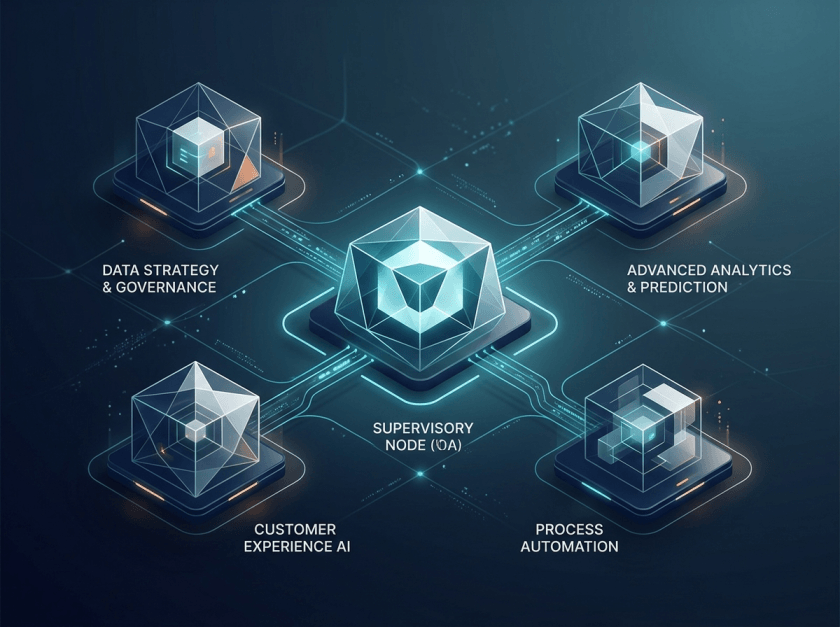
- Hierarchical Planning (LangGraph State Machines): A managed workflow with supervisor agents ensuring compliance and state integrity.
Choosing the wrong one is the primary reason AI pilots fail to scale. This guide breaks down each architecture's business value, cost profile, and best-fit use cases.
Why Does Architecture Matter in AI?
In 2024 and 2025, we saw a massive wave of "AI wrappers" which were simple interfaces on top of ChatGPT. By 2026, the market has matured. Enterprise leaders now realize that the model (e.g., GPT-4o, Claude 3.5, Gemini) matters less than the system architecture wrapping that model.
Architecture determines reliability, cost, and latency. A Multi-Agent System might produce higher quality code than a single agent, but it will cost 5x more in token usage and take 3x longer to respond. Conversely, a simple Tool-Use agent is fast and cheap but lacks the reasoning depth to handle ambiguity.
At Vector Labs, we have seen millions of dollars wasted on over-engineering. We’ve also seen critical failures where a simple RAG system was deployed when a Reasoning agent was required. The architecture is the product. Understanding these five patterns is no longer just for CTOs. It is a requirement for any executive funding AI initiatives.
1. ReAct (Reasoning + Acting)
The "Thinker-Doer" Loop
The ReAct pattern, popularized by researchers at Princeton and Google, stands for "Reason + Act." It broke the paradigm of LLMs being passive text generators. In a ReAct architecture, the model is prompted to generate a thought trace before taking an action.
How it works: Instead of just answering a question, the agent enters a loop:
1. Thought: "To answer this, I need to check the user's account balance."
2. Action: Call `check_balance(user_id)`.
3. Observation: The API returns "$4,500".
4. Thought: "The balance is sufficient. I will now transfer the funds."
Use Case: Financial Fraud Detection Vector Labs created a ReAct architecture for FinTech companies to handle suspicious transaction alerts. A simple rule-based system flagged too many false positives. The ReAct agent could "think" through the context: "The user is in France, but they bought a coffee in London 1 hour ago. This is physically impossible. I will flag this card." This reduced manual review volume by 60%.
Business Value: High adaptability. ReAct agents can handle unseen scenarios better than rigid code because they "reason" through the anomaly before acting.
2. Multi-Agent Systems (MAS)
The "Digital Workforce"
If ReAct is a single smart employee, a Multi-Agent System is a team or a department depending on the scale. In this architecture, you do not ask one generic AI to do everything. Instead, you spawn distinct "personas" with specific prompts and tools.
Coordination Patterns:
• Sequential Handoffs: Agent A (Researcher) passes a dossier to Agent B (Writer).
• Debate/Critic: Agent A generates code, Agent B (Reviewer) critiques it, Agent A fixes it.
• Hierarchical: A "Manager" agent breaks down a goal and assigns sub-tasks to "Worker" agents.
Use Case: Manufacturing Quality Control
For a manufacturing client, we built a trio of agents. Agent 1 (Vision) analyzed camera feeds for defects. Agent 2 (Logistics) checked inventory for replacement parts. Agent 3 (Maintenance) scheduled the repair technician. A single model trying to do all three hallucinated frequently. By separating concerns, we achieved above 97.5% process accuracy.
Business Value: Solves the "context window" problem and improves quality through specialization. However, it significantly increases latency and token costs.
3. Agentic RAG (Retrieval-Augmented Generation)
The "Autonomous Researcher"
Traditional RAG fetches documents based on keywords. Agentic RAG is smarter. It doesn't just fetch; it formulates a research strategy. It might decide that the first search result was insufficient, re-write its own search query, and try again. It can "read" a document, realize it needs a citation from a different year, and go find that specific cross-reference.
Use Case: Pharma Regulatory Compliance A pharmaceutical client needed to scan 20 years of FDA correspondence to answer queries like "Has the FDA ever rejected a mechanism of action similar to Drug X?" Standard search failed because the answer wasn't in one document. Our Agentic RAG system broke the question down, retrieved documents from three different decades, synthesized a timeline, and provided a cited answer. This cut regulatory research time from weeks to minutes.
Business Value: Essential for knowledge-heavy industries (Legal, Pharma, Insurance). It turns your static data lake into an active consultant.
4. Tool-Use / Function Calling
The "Enterprise Router"
This is the most deterministic architecture. The AI is essentially a natural language interface for your existing APIs. It is trained specifically to output JSON objects that trigger software functions. It doesn't "think" deeply about the philosophy of the request; it focuses on mapping "I need to book a meeting with Sarah" to `calendar.book_slot(attendee='Sarah')`.
Use Case: Private Hospital Booking System We worked with a private hospital network to streamline patient appointment management. Front-desk staff used to toggle between five different systems (EHR, scheduling, insurance verification, patient portal, billing). We built a Tool-Use agent integrated into their existing workflow. A receptionist could type "Book Mrs. Johnson for cardiology next Tuesday, check her insurance, and send appointment reminder." The agent called the scheduling API, verified insurance eligibility, blocked the calendar slot, and triggered the automated SMS reminder all in 3 seconds. It was pure automation, driven by natural language, reducing booking time from 8 minutes to under 1 minute.
Business Value: High speed, low cost, high reliability. Perfect for internal process automation where the steps are known but the interface is clunky.
5. Hierarchical Planning (LangGraph State Machines)
The "Managed Workflow"
As agents moved to production in 2025, we realized that "autonomy" is dangerous. You don't want an agent looping forever or hallucinating a process step. Hierarchical Planning (often built using tools like LangGraph) introduces a "Supervisor" or a State Machine.
How it works: The system moves through defined states (e.g., `Research` -> `Draft` -> `Review` -> `Publish`). The AI can be autonomous within a state, but it cannot move to the next state without satisfying specific criteria (like passing a compliance check). If it fails, the graph routes it back to the previous step.
Business Value: This is the "Enterprise Grade" architecture. It provides the flexibility of GenAI with the guardrails of traditional software engineering. It is the only architecture we recommend for finance or healthcare core processes.
Comparison: Choosing the Right Architecture
| Architecture | Best For | Complexity | Cost | Time to Value |
|---|---|---|---|---|
| ReAct | General problem solving, unknown inputs | Medium | Medium ($$) | Fast (2-4 wks) |
| Multi-Agent | Complex, multi-step creative or analytical tasks | High | High ($$$) | Slow (8-12 wks) |
| Agentic RAG | Deep research, compliance, legal analysis | Medium | Medium ($$) | Medium (4-6 wks) |
| Tool-Use | Automating rote tasks, API integrations | Low | Low ($) | Fast (2-3 wks) |
| Hierarchical | Mission-critical business processes, regulated flows | Very High | High ($$$) | Slow (12+ wks) |
How to Choose the Right Architecture?
At Vector Labs, we use a simple "Risk vs. Creativity" framework to decide.
1. Is the process strictly defined?
If yes (e.g., "If X, then Y"), do not use complex agents. Use Tool-Use or standard automation. AI should only be the interface.
2. Does the task require "point of view" or critique?
If you need the system to improve its own work (like writing code or legal briefs), use a Multi-Agent System with a critic/reviewer node.
3. Is the source data vast and unstructured?
If the answer is buried in PDFs, emails, or SharePoint, Agentic RAG is the only viable path.
4. Can failure be tolerated?
If an infinite loop or a wrong action costs money (e.g., executing trades), you must use Hierarchical Planning (State Machines) to enforce guardrails. Pure autonomous agents are too risky for Level 4/5 autonomy in enterprise settings.
Conclusion
Agentic AI is no longer just a technical concept for engineering teams. It is becoming a strategic design decision for business leaders. The organisations that create real value with AI will not be the ones chasing the latest model, but the ones choosing the right architecture for the right problem. Whether the need is rapid automation, deep research, multi-step reasoning, or tightly governed workflows, the architecture determines how reliably AI performs in the real world. For enterprise leaders, that makes architectural clarity a competitive advantage and increasingly, a prerequisite for scaling AI beyond the pilot stage.
If you are exploring where agentic AI can create the most value in your business, Vector Labs can help you assess the opportunity, choose the right architecture, and turn AI ambition into an operational roadmap. Book a strategy call with us to identify the highest-impact use cases and the design pattern best suited to your organisation.
FAQs
For tasks requiring simple data retrieval, RAG (Retrieval-Augmented Generation) is usually the most cost-effective. For operational automation, single-agent Tool-Use is generally cheaper than complex Multi-Agent systems because it involves fewer LLM calls (tokens) and less recursive looping.
Standard LLMs provide a static response based on training data. ReAct (Reasoning + Acting) allows the AI to "think" about a problem, take an action (like searching the web or querying a database), observe the result, and then answer. It turns the LLM into an active problem solver rather than a passive text generator.
Use Multi-Agent Systems (MAS) when a workflow requires distinct personas or expertise that would conflict if held by one agent. For example, a "Creative Writer" agent and a "Legal Compliance" agent debating a draft produces better output than one agent trying to be both creative and restrictive simultaneously.
LangGraph is a library/tool that enables the "Hierarchical Planning" or state-machine architecture. It allows developers to build cyclical graphs where agents have memory and specific state transitions, unlike linear chains which are brittle.
RAG is often a component of an agent. While simple RAG is just retrieval, "Agentic RAG" involves an agent deciding when to search, what to search for, and how to synthesize the results. It shifts RAG from a search bar to a research assistant.
The primary risks are infinite loops (agents getting stuck trying to solve a problem and burning cash) and hallucinated function calls (agents triggering APIs incorrectly). Hierarchical planning architectures mitigate this by adding supervisor nodes that can force-stop or redirect the agent.
Absolutely. Most enterprise-class systems are hybrid. For example, a Supervisor agent might use ReAct logic to delegate tasks to a subagent who uses RAG to find information, while another subagent uses Tool-Use to update the CRM.
A simple Tool-Use or RAG agent can be prototyped in 2-4 weeks. Complex Multi-Agent Systems or Hierarchical State Machines for regulated industries typically require 12-16 weeks to ensure reliability, proper guardrails, and integration testing.