







Why Open Source Infrastructure Projects Ship Governance Before Features: Lessons for Enterprise AI Platforms

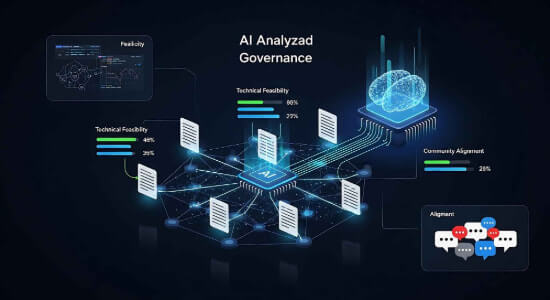
The most instructive thing about how mature open source infrastructure projects are built is not the features they ship. It is the order in which they ship things. Apache Iceberg's V4 constraint specification and the governance structures that have defined OpenSearch's community model both reflect a deliberate sequencing: define the rules of the system before you scale the system's adoption. Enterprise platform teams building internal AI and data lakehouse infrastructure tend to do the opposite, and the cost of that inversion shows up in production.
The Pattern That Open Source Gets Right
Apache Iceberg's V4 constraint spec is not primarily a feature addition. It is a formalization of what the table format is allowed to do to data, who can authorize those operations, and under what conditions enforcement happens. The spec introduces constraint primitives at the catalog layer, which means enforcement is not delegated to application logic sitting above the table. It is embedded in the contract that all readers and writers must honor.
This design choice has a specific commercial consequence. Any engine that integrates with Iceberg inherits the constraint model without requiring a separate negotiation about enforcement. The governance surface does not grow linearly with the number of integrations. It stays fixed at the spec level.
OpenSearch's governance story follows a similar logic. When AWS forked OpenSearch from Elasticsearch in 2021, one of the first structural decisions was to establish a formal governance model: a technical steering committee, a defined process for accepting contributions, and explicit rules about release authority. These were not features. They were the conditions under which feature development could proceed at scale without the project fragmenting under the weight of competing priorities.
Why Enterprise Platform Teams Get This Backwards
The typical enterprise AI platform build starts with capability delivery. A team ships a feature store, a model registry, a vector index, or a lakehouse layer because there is immediate business pressure to demonstrate value. Governance questions, including who owns data contracts, how schema changes are authorized, and what happens when a model update breaks a downstream consumer, get deferred to a later phase.
The mechanism that makes this painful is not complexity in isolation. It is the accumulation of implicit assumptions. Every pipeline built before a constraint model exists encodes its own local understanding of what the data contract means. By the time a formal governance layer is introduced, the platform team is not designing governance. They are reverse-engineering hundreds of implicit contracts that were never written down, and negotiating with teams who have built production dependencies on the informal behavior.
This is not a failure of intention. It is a structural consequence of treating governance as a product layer rather than as a specification that defines the product's behavior from the start.
What Constraint-First Design Actually Means in Practice
Constraint-first design does not mean building a compliance dashboard before building a data pipeline. It means deciding, at the schema and API contract level, what invariants the platform will enforce and what it will leave to application logic.
Ownership at the Contract Layer
In Iceberg's model, constraints live at the catalog layer because the catalog is the single authority that all compute engines consult before reading or writing. Enterprise platform teams can apply the same principle by defining data ownership, schema change authorization, and lineage requirements as properties of the data contract itself, not as policies documented in a wiki that nobody reads before deploying a pipeline.
Enforcement as a First-Class Engineering Deliverable
The distinction that matters is between a governance policy and a governance mechanism. A policy describes what should happen. A mechanism makes the alternative structurally impossible or at minimum auditable. Enterprise AI platforms that treat enforcement as an engineering deliverable from day one tend to have significantly smaller incident surface areas when they scale, because the rules are not dependent on every team remembering to follow them.
The Accountability Gap That Production Exposes
When a constraint model is absent at the platform layer, accountability defaults to informal social structures. A pipeline breaks because a schema changed without notice, and the post-mortem conversation is about who should have told whom. The answer is almost always that nobody had a formal obligation to tell anyone, because the platform never encoded that obligation.
Open source projects like OpenSearch solved this not by creating more communication channels but by making certain actions require explicit authorization from a defined role. A release cannot happen without steering committee sign-off. A breaking API change requires a documented deprecation path. These are not bureaucratic additions. They are load-bearing structures that allow the project to scale contributor volume without increasing coordination overhead proportionally.
Enterprise data and AI platforms face the same scaling problem. As the number of teams consuming a shared platform grows, informal coordination breaks down at a predictable rate. The only durable solution is to encode accountability into the platform's operating model before the platform reaches the scale at which informal coordination fails.
What Platform Leaders Should Borrow From This Discipline
The practical transfer from open source governance to enterprise platform design involves three concrete shifts in how platform work is scoped and sequenced.
First, treat the data contract specification as a deliverable with the same priority as the first pipeline. Define what fields are guaranteed, what schema evolution is permitted, and who has authority to approve changes before any downstream team builds a production dependency on the data.
Second, define enforcement mechanisms at the platform layer rather than at the application layer. If a constraint can be bypassed by an application team without a platform-level intervention, it is not a constraint. It is a suggestion.
Third, establish ownership structures before adoption scales. The OpenSearch steering committee model works because it was defined when the contributor base was small, which meant the rules were established before anyone had a vested interest in the absence of rules. Enterprise platform teams that wait until they have thirty consuming teams to define data ownership will find that each of those teams has already built assumptions about how ownership works, and those assumptions will not be compatible with each other.
The argument here is not that governance is more important than capability. It is that governance is harder to retrofit than capability, and that the cost of the retrofit is paid by the platform team while the benefit of the deferral was captured by whoever shipped the first feature.
Companion piece to our broader work on enterprise AI governance. See Governance Without Gatekeeping: How Enterprise AI Teams Should Navigate the Open Source Policy Shift for a strategic guide to open model governance, compute limits, and vendor strategy in enterprise AI procurement decisions.
FAQs
It means defining the invariants your platform will enforce at the contract or catalog layer before any downstream team builds a production dependency on your data. This includes schema evolution rules, ownership assignment, and the authorization process for breaking changes. The goal is to make enforcement structural rather than procedural, so compliance does not depend on every team remembering to follow a policy document.
Every pipeline built before a formal constraint model exists encodes its own implicit assumptions about what the data contract means. When you introduce governance after the fact, you are not designing rules. You are reverse-engineering hundreds of undocumented assumptions and negotiating with teams that have production systems depending on informal behavior. The coordination cost scales with the number of consuming teams, not with the complexity of the governance model itself.
Iceberg's V4 spec places constraint enforcement at the catalog layer, which is the single authority all compute engines consult before reading or writing data. This means any engine integrating with Iceberg inherits the constraint model automatically. Enterprise platforms can apply the same principle by encoding data ownership, schema authorization, and lineage requirements into the data contract itself rather than into application-level policies that downstream teams can bypass.
A policy describes what should happen. A mechanism makes the alternative structurally difficult or impossible. Most enterprise platform governance failures involve policies that were documented but not enforced at the platform layer, leaving compliance dependent on application teams choosing to follow the rules. A mechanism, by contrast, requires explicit authorization for certain operations, which means violations are either prevented or immediately auditable rather than discovered after the fact in a post-mortem.
Before adoption scales, not after. The OpenSearch governance model worked because the steering committee structure was defined when the contributor base was still small, which meant the rules were in place before any party had a vested interest in the absence of rules. Enterprise platform teams that wait until they have a large number of consuming teams will find that each team has already built incompatible assumptions about ownership, and reconciling those assumptions is significantly more expensive than defining them upfront.
More Articles
 8 mins read

 AI Governance Without Business Alignment Is Just Theater: What CIOs Are Getting Wrong About Control
A strategic guide to why AI governance frameworks fail when decoupled from business outcomes, cover…
Security
Oct 28, 2026
8 mins read
Open Source AI Models and the Supply Chain Risk Nobody Has a Framework For Yet
A practical guide to evaluating third-party model risk in enterprise deployments, covering network …
Agentic AI
Oct 28, 2026
7 mins read
Shipping a Thousand Pull Requests a Week: The Quality Infrastructure Engineering Leaders Must Build Before Scaling AI Agents
A practical guide to maintaining code correctness and engineering accountability at AI-generated ve…